
Non Woven Geotextile Fabric Factory Essentials Every Buyer Should Know
2026-09-19
Buying non woven geotextile fabric from a factory shouldn't feel like a gamble. Yet too many buyers learn the hard way that not all production lines are equal—fiber quality, roll consistency, and even testing methods vary wildly from one supplier to the next. This guide cuts through the noise. We'll walk you through the essential checks every buyer should make before placing an order, from raw material sourcing to final QC. And if you're looking for a partner that already meets these standards, Jinseed Geosynthetics Solution is a name worth knowing.
The Polymer Choice Most Non Woven Geotextile Buyers Overlook
Many nonwoven geotextile buyers treat polymer selection as an afterthought. Polypropylene is the default because it costs less and meets standard specifications, but that habit masks a real gap. In applications where ultraviolet exposure, high soil alkalinity, or sustained tensile loads are present, polyester nonwovens often hold up far better. The result is that projects get specified with a material that passes initial tests but degrades faster than expected once exposed to real site conditions.
Polyester fibers bring inherent advantages that polypropylene cannot match without expensive additive packages. They resist UV radiation more effectively, retain strength at higher temperatures, and show much lower creep under constant load. For drainage trenches, road separation layers, or erosion control blankets exposed to sunlight during long installation windows, these differences decide whether the fabric still functions after two seasons or starts tearing during backfill.
The overlooked polymer choice is seldom about exotic chemistry; it is usually a straightforward switch from polypropylene to polyester in the right context. Instead of focusing only on weight or puncture resistance, buyers should ask what happens after six months in the sun or in contact with lime-treated subgrade. That one question often reveals why polyester, despite a slightly higher upfront price, delivers lower total cost and fewer callbacks.
How Needlepunch Lines Shape Fabric Strength and Filtration
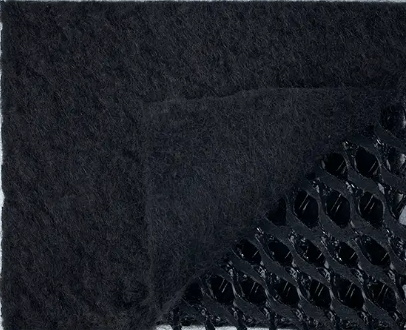
The orientation and density of needlepunch lines directly influence how a nonwoven fabric handles mechanical stress. When barbed needles repeatedly penetrate the fiber web, they reorient loose fibers into vertical columns, creating a three-dimensional entanglement that resists pulling forces in multiple directions. A tighter line spacing means more fiber interlocking per square centimeter, which typically translates to higher tensile strength, but only up to a point—over-needling can break fibers and create weak spots that actually reduce durability.
Filtration performance is tied to how those needlepunch paths alter the pore structure between fibers. Each needle pass drags bundles of fibers downward, leaving behind elongated channels that vary in size depending on needle gauge, penetration depth, and line pattern. A diagonal or zigzag line arrangement tends to produce more tortuous pathways for air or liquid flow, which improves particle capture without a steep rise in pressure drop. Manufacturers often adjust the line design to balance dirt-holding capacity against airflow resistance, especially in applications like automotive cabin filters or industrial dust collection.
Beyond static properties, the interaction between adjacent needlepunch lines affects how the fabric behaves under cyclic loading and repeated filtration cycles. If lines are too uniform, the fabric may develop preferential weak planes along the stitching direction, leading to premature tearing or channeling during use. Slight randomization of line spacing—while keeping overall density consistent—creates a more isotropic structure that distributes stress and flow more evenly, extending both the mechanical life and the stable filtration efficiency of the final nonwoven material.
Quality Control Steps That Unreliable Factories Tend to Skip
A lot of factories will tell you they inspect every shipment, but walk their floor and you might not see a single calibrated gauge in sight. The first thing that gets dropped is incoming material verification. They trust the supplier's word on alloy grade, fabric weight, or component tolerances, and only discover the mismatch after parts start failing in the field. Then there's the in-process check. Instead of stopping a line when dimensions drift, they keep running and hope the final sort catches the bad pieces—which it never fully does once volume ramps up.
Another quiet skip is documentation. Reliable shops keep a record of what was checked, what passed, and what got reworked, so a problem six months later can be traced to a batch or a shift. Unreliable ones often rely on memory or a single overworked supervisor who was never given the authority to halt production. You'll also see final inspection reduced to a visual glance: a quick look for scratches or missing labels, while functional tests, torque checks, and leak tests quietly disappear from the routine.
Calibration and tool maintenance are often the first line items cut when budgets get tight. Gauges that haven't been verified in years still get used to accept parts, and worn cutting tools keep running until the scrap rate becomes someone else's problem. The pattern isn't hard to spot—if the factory can't show you which step is owned by whom, or if the answer to "what happens when you find a defect?" is vague and slow, assume those quality gates aren't really there.
Why Custom Roll Widths and Lengths Aren't Always Straightforward
Custom roll sizes seem like a simple request—just specify the width and length and wait for delivery. In practice, every dimension pulls on a different part of the production process. A specific width may require a dedicated slitting setup, while a non-standard length can force the line to stop and restart mid-run, increasing labor and waste.
Material behavior adds another layer of complexity. Film, paper, and foil all expand or contract with temperature and tension, so a roll cut to exactly 48 inches at one point in the day might measure slightly off later. Edges can also wander if the core isn't perfectly aligned or if the tension profile shifts during winding, leaving you with telescoped rolls that measure fine on paper but fail on the machine.
Then there's the commercial side. Unusual dimensions often mean leftover master rolls that can't be repurposed easily, so suppliers build in surcharges or higher minimums. If you need a very narrow width or an odd length, expect a conversation about tolerances, core sizes, and splice allowances before the quote makes sense.
How to Read Tensile and Puncture Reports Without Getting Misled
Most people skim a tensile or puncture report for the headline numbers—peak force, elongation at break, energy to puncture—and take them at face value. But those figures are only as trustworthy as the test setup behind them. A report that doesn’t state specimen thickness, conditioning time, or crosshead speed is essentially asking you to compare apples to oranges. Before you believe any result, check whether the sample was die-cut cleanly (ragged edges can initiate premature failure), whether the gauge length matches the standard you care about, and whether the machine was properly zeroed. A five-percent difference in reported strength might just be an artifact of a dull blade or a hurried operator.
Another common trap is over-relying on average values while ignoring the scatter. Two materials might both show an average tensile strength of 30 MPa, yet one fails consistently between 29 and 31 MPa while the other bounces from 22 to 38 MPa. The second material is a gamble in real-world loading, even if its average looks identical. Look at the coefficient of variation, the number of specimens tested, and whether any outliers were silently dropped. A responsible report will tell you if a specimen failed outside the gauge section or if a puncture probe hit an unusually hard filler particle. If that information is missing, you’re not reading a report—you’re reading a sales brochure.
Finally, pay attention to the failure mode, not just the force at break. A tensile curve that ends with a sharp, brittle snap tells a completely different story from one that shows a long necking plateau, even if both peak at the same load. For puncture tests, check whether the probe fully perforated the sample or merely caused a crack. A material that resists puncture through high stiffness might fail catastrophically once a crack starts, while a more flexible material could absorb more total energy despite a lower initial resistance. Always ask for the raw stress-strain or force-displacement curve. Any report that gives you only a single number is hiding the part that actually matters.
Lead Times and Packaging Surprises That Delay Geotextile Projects
It rarely gets mentioned in the pre-bid meetings, but the way geotextile rolls are packed and shipped can quietly eat up project schedules. A standard container might hold fewer rolls than expected because of oversized cores or awkward wrapping, forcing multiple shipments for what looked like a single-order job. When the final roll finally arrives, the crew often discovers that the packaging itself has become a problem: heavy plastic wrap that tears into confetti, steel bands that need cutting and disposal, or rolls so tightly compressed that the outer layers are permanently creased. Those creases are not cosmetic—they can change the effective permittivity or create thin spots that fail a CQA inspection on day one.
Lead times are the other quiet disruptor. Many suppliers quote four to six weeks for a standard woven monofilament, but once you add a custom width, a non-stock weight, or a specific UV stabilization package, the real wait can stretch to ten or twelve weeks without any warning. The problem compounds when the project engineer specifies a particular brand and model for a critical interface, leaving no room for substitution. A late geotextile delivery then cascades: the subgrade sits exposed through an extra rain cycle, the aggregate base gets pushed back, and the paving crew idles. Nobody gets fired for ordering early, but plenty of schedules have been wrecked by trusting a vendor's optimistic promise.
What usually gets overlooked is how packaging choices interact with site storage. Rolls wrapped in thin, non-UV-resistant film will start to degrade if left in direct sunlight for more than a couple of weeks, even though the geotextile itself is UV-stabilized. Some manufacturers use biodegradable twine or water-soluble labels that sound eco-friendly but dissolve in a morning dew, leaving stacks of unlabeled rolls that have to be re-identified by weight and width. Others pack so many rolls on a single pallet that a forklift cannot safely unload them without double handling. The smart move is to ask for a packing list with roll dimensions, core size, and wrapping material before signing the purchase order—and to build a two-week buffer into the project schedule for the surprises that always seem to arrive with the truck.
FAQ
Look beyond glossy brochures—ask for production line details, monthly output in square meters, and whether they run needle-punched or thermal-bonded processes. A quick video call during operating hours often reveals more than a spec sheet.
Request batch records and raw material test certificates, not just final product samples. Factories that track basis weight, tensile strength, and puncture resistance per roll are usually the ones that catch defects before shipping.
Premium factories typically use virgin polypropylene or polyester staple fibers, not recycled scrap with unknown origins. Ask for polymer grade details and check for odors or uneven fiber distribution in samples.
Not really, but setups vary. Many lines handle widths from 1 to 6 meters and rolls up to 300 meters. Confirm minimum order quantities for custom slitting—some smaller factories hesitate below 5,000 square meters.
ISO 9001 is a baseline, but look for CE marking if you sell into Europe, or specific standards like ASTM D4632 for grab tensile strength. Don't treat certifications as guarantees; request test reports from independent labs.
Ask about current order backlog and raw material inventory, not just theoretical production speed. Factories that buy fiber only after receiving your deposit often need an extra 10–15 days. Lock in a production schedule with penalty clauses.
Normalize everything to cost per square meter at a fixed weight, say 200 gsm, and include packing, inland freight, and port charges. A lower unit price sometimes hides thinner fabric or weaker tensile strength.
If the order exceeds $30,000, an on-site visit or third-party inspection is worth the cost. You'll see whether the warehouse is organized, how workers handle rolls, and if the claimed machines actually match the photos.
Conclusion
While most buyers compare weight and thickness, the polymer choice quietly determines how the fabric behaves underground. Polypropylene dominates for general drainage and separation because of its chemical inertness and lower cost, but polyester offers better resistance to high pH soils and prolonged UV exposure. Overlooking this leads to premature embrittlement or loss of filtration efficiency. Equally important is the needlepunch line itself: needle density, penetration depth, and web layering control both tensile strength and pore size distribution. A factory that rushes the line or ignores needle wear produces fabric that passes a lab grab test but fails in the field with channeling or clogging. Reliable suppliers track raw material melt flow, fiber denier, and nonwoven basis weight every few hours, while less diligent ones skip these in-process checks and hope the final roll hides the variation.
Custom roll widths and lengths sound simple, but each change wastes edge trim, alters tension profiles, and can create telescoping if the winder is slightly off. Roll length is not just a number on a label; uneven winding leads to core crushing and unwinding problems at the job site. When reading tensile and puncture reports, pay attention to the test direction (machine vs cross), specimen conditioning, and elongation at break, because a high grab tensile with low elongation will tear rather than stretch. Puncture strength numbers are meaningless without knowing the probe diameter and test speed. Finally, lead time surprises often come from polymer pellet shortages or packaging mismatches: wrong core inner diameter, missing UV-resistant wrap, or vague roll markings cause port delays and re-handling. Ask the factory to photograph the finished rolls before shipment and confirm loading plans, not just the production date.
Contact Us
Contact Person: Jerry Qiu
Email: [email protected]
Tel/WhatsApp: +65 84265294
Website: https://www.jinseed-geo.com