

KYN28-12 Medium Voltage Switchgear Factory: Inside Modern Manufacturing and Quality Control
2026-11-02
Most people never think about the switchgear that keeps their lights on—until it fails. At MOLDVOLT, the KYN28-12 medium voltage switchgear isn't just assembled; it's engineered through a gauntlet of modern manufacturing steps and brutal quality checks. From copper busbar bending to partial discharge testing, this inside look reveals why reliability is built, not promised.
Raw Steel In, Switchgear Out: A Walk Through the KYN28-12 Line
The KYN28-12 line doesn't announce itself with fanfare. It begins with raw steel sheets stacked near the cutting station, their edges still sharp from the mill. From there, the material moves through a sequence that feels less like a production line and more like a deliberate act of transformation. Operators feed panels into CNC punches and laser cutters, where precise openings for busbars, breakers, and cable compartments take shape. Every component is handled with a kind of quiet familiarity—no rushed motions, just the steady rhythm of metal meeting tool.
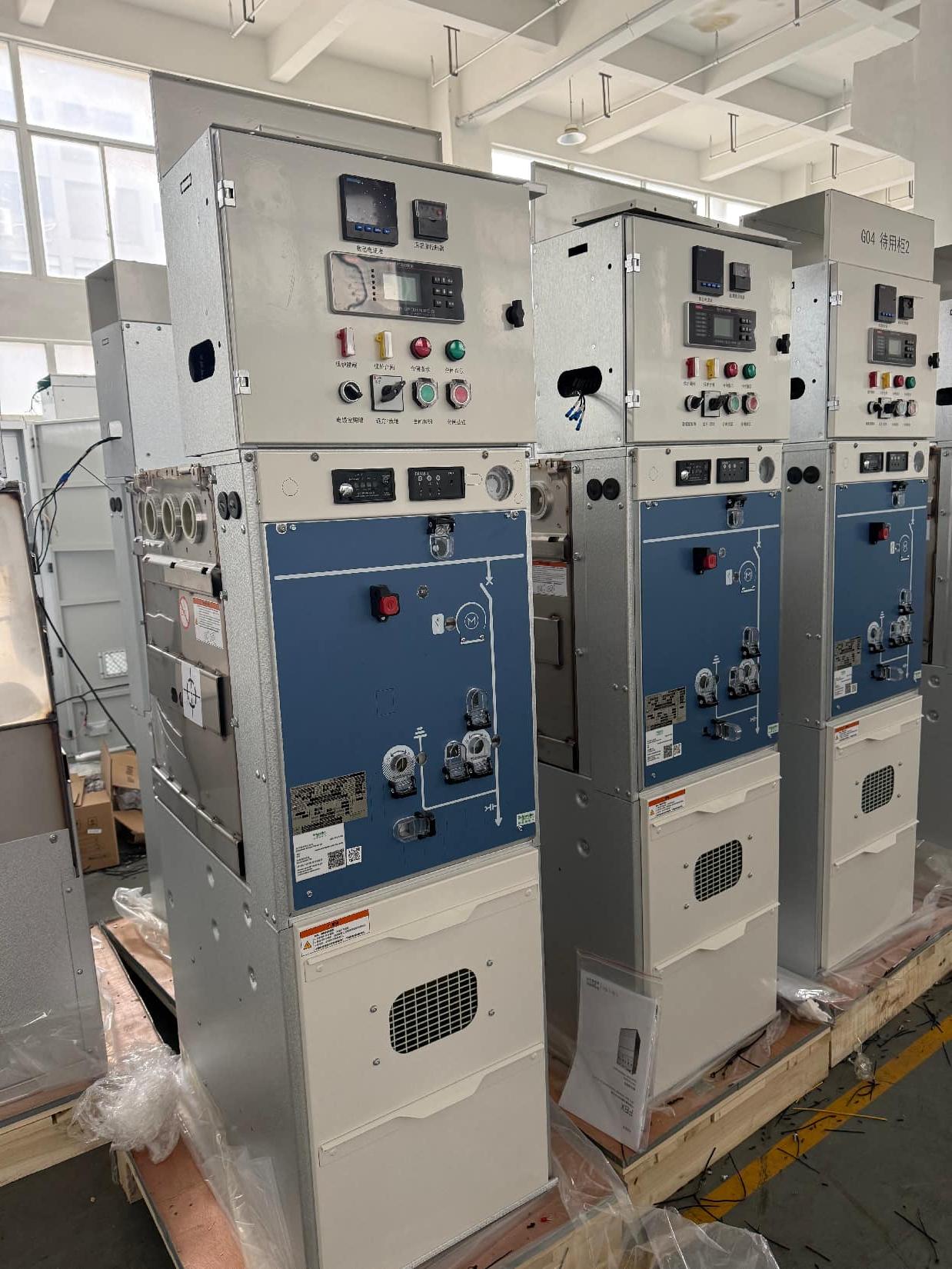
Walk further down, and the smell of welding hangs faintly in the air. Frames are assembled, corners squared, and surfaces ground smooth before heading to the powder coating booth. The switchgear enclosures emerge in their familiar light gray, but the process is anything but generic. Each cabinet is checked for dimensional accuracy, then fitted with busbar supports, earthing switches, and withdrawable circuit breaker trucks. The assembly stations are arranged so that a single unit moves from mechanical assembly to electrical wiring without backtracking—an elegant choreography that keeps the line flowing.
At the far end, the finished KYN28-12 panels undergo routine tests: dielectric withstand, mechanical interlock verification, and a final visual inspection. The raw steel that entered hours earlier has become a fully functional medium-voltage switchgear, ready to be crated and shipped. What stands out is not any single machine, but the blend of heavy fabrication and careful handwork. It is a line built on repetition, yet each panel carries its own small deviations—a slightly different torque here, a custom label there—reminders that industrial production still leaves room for human judgment.
Precision Bending and Robotic Welding: How the Frame Takes Shape
Every chassis starts as a stack of laser-cut steel blanks, but the real character emerges at the press brake. Operators dial in bend allowances to within half a degree, accounting for springback that varies with grain direction and sheet thickness. A 2 mm plate bends differently on a cold morning than after lunch, so the back gauge gets nudged constantly. No two bends are trusted on assumption alone; the first part off the brake is checked against a granite surface plate before the batch runs.
From there, the formed sections move to a tandem robotic welding cell where the torch follows pre-taught paths with repeatability that human hands can't match. The robots don't get tired, but they do demand clean fit-up. Clamps and locators hold each rail and crossmember within 0.2 mm, because even a small gap changes weld penetration. Air-cooled torches run hot through the afternoon, yet the bead profile stays consistent enough that destructive testing on a sample frame rarely finds a weak joint.
What finally rolls off the fixture isn't just welded metal; it's a frame that has absorbed hundreds of micro-adjustments along the way. The bend lines align with the load paths, the welds sit where stress concentrates, and the twist measured at the suspension mounts comes in under a millimeter. That kind of result doesn't come from a single machine—it comes from operators who know when to override a program and when to let the robot do its work.
Busbar Assembly and Insulation: The Electrical Heart of KYN28-12
In KYN28-12 cabinets, busbar work starts with copper bar cutting, bending, and hole punching before any insulation goes on. The main horizontal busbar and drop-down branch bars are then assembled with high-strength bolts, but the real difference comes from controlling bolt torque and the flatness of contact surfaces. A slightly uneven joint will heat up quickly under rated current, so tinned copper bars and torque wrenches are standard on the floor, not optional extras.
Insulation around these bars is not just a sleeve pushed over the copper. Heat-shrink tubing is applied with enough overlap at joints, epoxy resin support insulators are placed to handle mechanical stress during short circuits, and phase barriers are inserted where clearances cannot be guaranteed in the compact compartment. The weak points are always the bends and bolted connections, where the electric field concentrates and where partial discharge can start if the insulation shrinks back even a few millimetres.
After assembly, a proper KYN28-12 busbar compartment is tested with AC withstand voltage and partial discharge measurements, not just a quick continuity check. Any corona or surface tracking in the test bay means the insulation has to be stripped and redone, because this assembly is what carries power through the entire switchgear lineup.
Clean Room Standards on the Factory Floor: Why Dust Control Matters
A single speck of dust barely visible to the eye can ruin a batch of precision components or pharmaceutical vials. On the factory floor, clean room standards exist because uncontrolled particulate matter leads directly to product defects, rejected lots, and costly rework. Even in less regulated manufacturing, dust buildup on conveyors, sensors, and tooling accelerates wear and causes intermittent equipment faults that are hard to trace.
Effective dust control starts with classifying the space according to ISO 14644 or equivalent federal standards, then matching filtration and airflow to that class. HEPA or ULPA filters, positive room pressure, and sticky mats at entry points work together to limit how many particles enter and how long they linger. Equally important are operational habits: workers who skip gowning procedures or bring cardboard into the area can undo the best engineered system. Routine particle counting and surface sampling make the invisible threat visible, so teams can catch drift in conditions before defects appear.
Beyond protecting the product, dust control protects people and the bottom line. Fine particulates from cutting, grinding, or chemical handling can pose respiratory hazards, and many regulatory bodies set permissible exposure limits. A clean environment also shortens cleaning downtime and extends the life of sensitive instruments. When the cost of one contaminated lot can exceed a year of filter replacements, the case for rigorous dust management writes itself.
Pushed Past Spec: Routine Tests That Challenge Every Panel
Most datasheets are written for a bench at 25°C and 50% relative humidity. Our routine is less polite. Every panel gets ramped from -40°C to +85°C in under an hour, held at each extreme, then soaked for 48 hours at 85% humidity. We're not just looking for outright failure—we're watching for micro-cracks in the coating, early corrosion on connectors, and output drift that only appears after the chamber door opens again.
Then the panel moves to the vibration table. It's bolted down and swept from 10 Hz to 500 Hz at rising g levels across all three axes. While it shakes, we run live performance checks to catch intermittent drops that a static bench would miss. After that, the frame and mounting points go through 10,000 flex cycles, because thermal expansion and rough handling stress the edges far more than any spec sheet test.
Panels that make it through aren't just 'within spec'—they've endured conditions that would void most warranties. That's the whole point. If a panel survives repeated cold starts, deep humidity, and frame flex without losing output or developing hidden fatigue, it's earned the right to be called pushed past spec.
Traceability from Coil to Customer: The Hidden Paper Trail
In a coil processing line, the steel itself moves through slitting, leveling, and blanking without much drama, but the paper behind it often determines whether a heat number survives to final shipment. Tags get copied by hand, remnants get combined after a partial run, and the original mill certification can quietly drift away from the coil it belongs to. By the time the finished parts reach the customer, the trail may already be broken.
Much of this traceability lives in receiving logs, shop travelers, remnant stickers, and final packing slips. Each handoff is a small risk: a digit gets transposed, a heat code gets shortened, or a tag gets taped to the wrong skid. When a customer's incoming inspection flags a mismatch, the search usually starts at the warehouse rack rather than inside the ERP system, because the physical labels and handwritten notes are what the operator actually touched.
A surprising number of shops still lean on signed travelers and simple coil tags tucked into protective sleeves. That approach is not flashy, but it leaves an audit path that can survive a software update or a sudden change in staff. The real difficulty is keeping every mark legible and making sure the latest remnant tag follows the correct coil all the way to the last cut piece that goes out the door.
FAQ
KYN28-12 is a metal-clad switchgear rated for 12kV, commonly used in power distribution for industrial plants, substations, and infrastructure. It houses vacuum circuit breakers, busbars, and protection relays in a compartmentalized steel enclosure to prevent arc faults.
Precision sheet metal starts with CNC laser cutting and turret punching, followed by bending on press brakes with angle correction. Panels are checked against CAD models using coordinate measuring machines at critical stages, keeping tolerance within ±0.5 mm.
After assembly, each cubicle undergoes visual inspection, torque verification on busbar joints, and dielectric tests. We also check interlock mechanisms, grounding continuity, and door alignment. Any deviation triggers a rework tag and root cause analysis.
Testing includes routine tests per IEC 62271-200: power frequency withstand voltage, lightning impulse where specified, partial discharge measurement, and mechanical operation of the breaker. We also run a heat rise test on random samples and verify auxiliary circuits with a 2000-point continuity checker.
Core materials are 2mm alu-zinc coated steel for enclosures, epoxy resin insulators, copper busbars with tin plating, and vacuum interrupters from certified suppliers. Each batch has material certificates and we perform incoming inspection on dimensions and coating thickness.
Customization is handled through a modular design. Engineers use configurable 3D models where customers can specify busbar ratings, protection schemes, and cable entry. After order confirmation, a unique production BOM is generated, and laser marking adds project-specific labels to each compartment.
Safety features include internal arc classification (IAC AFLR), shutter mechanisms that block busbar access when the breaker is racked out, capacitive voltage indicators, and a pressure relief duct on top. The door can only be opened when the breaker is in test/disconnected position.
Traceability starts with a serial number laser-etched on the frame. Every major component—breaker, CTs, relays—is scanned into the MES system. Workers log torque values and test results electronically, and final quality dossier includes photos and certificates for each cubicle.
Conclusion
Walking the KYN28-12 line makes clear that this is not just assembly but a controlled build from raw coil to finished panel. Sheets arrive with heat numbers that stay linked through every cut, bend, and weld. The frame starts with precision bending on CNC press brakes, then robotic welding locks the cubicle geometry within tight tolerances. Busbar work follows as the electrical heart: copper is cut, punched, and sleeved, then torqued under clean-room discipline because even fine dust can breed partial discharge later.
Quality control is not a final checkpoint but a repeated challenge. Every panel faces routine tests—power-frequency withstand, lightning impulse, mechanical interlock checks—that push it past its nameplate specs. Behind the scenes, the paper trail ties coil certificates, weld parameters, insulation batch numbers, and test results to the serial number, so a customer can trace exactly what went into their switchgear and how it performed before shipping.
Contact Us
Contact Person: Hellen
Email: [email protected]
Tel/WhatsApp: 86-13634205622
Website: https://www.voltcabinet.com