
Bulk Metal Labels That Withstand the Toughest Conditions
2026-09-12
If your tags can’t survive the job site, they’re not labels—they’re liabilities. Bulk metal labels from Kingming are made for the worst your facility can throw at them: scorching heat, corrosive chemicals, rough handling, and years of UV exposure. Here’s why they keep performing when cheaper options fall apart.
Laser-Etched Codes That Survive Salt Spray, Sand, and Scrapes
Marking metal parts with permanent identification isn't just about ink that fades or stickers that peel. When equipment faces coastal humidity, abrasive grit, or daily mechanical wear, the code needs to be part of the surface itself. Laser etching achieves this by altering the material's microstructure, creating contrast that doesn't wash off or rub away. Think of it as engraving light into steel—the result is a high-resolution mark that remains legible even after the surrounding finish has dulled or oxidized.
The real test comes when those codes meet a salt spray chamber running ASTM B117 for hundreds of hours. Ordinary printed labels blister and dissolve, but a properly parameterized laser mark will show minimal degradation. The key is controlling heat input to avoid micro-cracking, which would give corrosion a foothold. Similarly, sand blasting or decades of boot traffic can't smooth over a deep-etched data matrix or serial number. Each pass of abrasive media may polish the surface, but the laser-ablated recesses retain their readability because they're microns below the original plane.
What separates durable laser codes from superficial ones is an understanding of how the metal's hardness, reflectivity, and alloy composition interact with pulse frequency and beam focus. For stainless steel, a dark annealed mark often outperforms a bright engraved one in harsh environments—the oxide layer formed during lasing acts as a protective barrier. Meanwhile, on aluminum, a shallow etch with a high contrast setting can survive years of sand-infused wind. The result is a code that doesn't just claim to be permanent; it proves it under conditions that destroy other marking methods.
When Acid Baths and Abrasion Are Just Tuesday
Most people flinch at the thought of dipping steel into a bubbling vat of hydrochloric acid, but for a handful of technicians, that's just the first coffee break. The routine starts with a hiss and a plume of vapor that would send a safety inspector reaching for a gas mask, yet the crew moves with the bored precision of someone refilling a stapler. Acid baths aren't chaos here; they're a predictable step between the grinder and the rinse tank, timed to the second and logged with a shrug.
Abrasion gets the same unglamorous treatment. Wire wheels scream against metal, sparks arcing into gloves that have more patches than original fabric. Newcomers tense up, waiting for the catch or the kickback, but veterans lean into the work like it's a porch swing. The trick isn't muscle; it's angle, pressure, and a willingness to let the tool do the complaining. By Thursday, even the intern stops wincing at the shower of embers.
That's the quiet truth of industrial finishing: what looks like hazard from the outside becomes ordinary texture from the inside. The acid's bite and the abrasive's grind aren't threats to be survived—they're just the cost of turning rough stock into something that fits, seals, or shines. You stop noticing the smell, the noise, the tiny burns. You notice instead whether the etch is even and the surface breaks light the way the spec sheet demands.
Custom Stamped Plates That Won't Fade in UV or Frost
We spent months testing different inks and coatings under harsh sunlight and freezing temperatures. The result is a stamping process that locks pigment deep into the metal surface, not just on top of it. Even after years of direct UV exposure, the lettering stays crisp and dark, instead of turning pale or peeling away.
Frost is another common killer of stamped plates. Moisture seeps into microscopic cracks, then expands when it freezes, causing the print to lift and flake. Our plates are sealed with a flexible, hydrophobic layer that prevents water intrusion without making the surface sticky or glossy. You can leave them outside all winter and they'll look the same in spring.
If you've ever had to replace faded equipment tags or faded address plaques, you know the frustration. These plates are made for people who want to install something once and forget about it. No touch-ups, no clear-coat sprays, no special cleaning routines. Just wipe them down and move on.
No More Reordering Labels Every Season
You know that drawer of label stacks where "Spring" and "Fall" have somehow become one tangled mess? The yearly ritual of peeling off old season tags, reprinting fresh ones, and hoping the right size ends up on the right shelf never quite worked. Not anymore.
With a single, season-proof labeling system, you set the template once and leave it. Colors, fonts, and layout stay consistent whether you're marking a summer sundress or a winter coat. No more hunting for that specific roll of label tape, no more half-scraped adhesive residue on the shelf edge. It just stays put.
The upside is time you get back. Instead of spending an afternoon every quarter redoing what you already did, you can use that hour to actually arrange the display, check inventory, or just close up early. Labels should work for you, not create another chore on the calendar.
Riveted, Wrapped, or Adhesive: Mount Them Your Way
Riveted mounts have a certain honesty to them. You drill clean holes, line up the plates, and press the rivets until they bite. The result is a connection that can handle vibration, heat, and the occasional clumsy knock. It is not the quickest method, but for anything that needs to stay put on a frame or panel, the extra ten minutes pays off.
Wrapped mounts suit fabric, webbing, and irregular shapes. Instead of puncturing the material, you fold the strap or clamp around it and let tension do the work. This avoids stress points and keeps the surface intact. It is also forgiving when you need to reposition things a few times before the final fit.
Adhesive tape has come a long way from basic double-sided strips. Modern acrylic foam tapes spread load evenly and resist weather better than many screws in light-duty setups. The surface must be clean and dry, but once applied, the bond is quiet, low-profile, and free of drill holes. Choose this when you want to mount without leaving a trace.
From Freezer Floors to Furnace Doors
Few places punish flooring quite like the walkway between a walk-in freezer and a heat-treat furnace. One side sweats and ices over; the other radiates enough heat to curl vinyl. A surface that survives both has to handle rapid thermal swings without buckling or turning slick.
That means the material itself has to shrug off moisture, salt, and stray embers in the same shift. Textured treads bite into boot soles even when condensation drips from a freezer door, and the backing stays flexible enough to bridge minor cracks in old concrete. Edges are often beveled to keep carts from catching during rushed handoffs.
Maintenance crews notice the difference most at the threshold itself, where frost and heat meet. Instead of swapping mats or patching blisters every few weeks, they hose the surface down and move on. It is less about one dramatic fix and more about not thinking about the floor while moving between minus twenty and four hundred degrees.
FAQ
They're built from stainless steel or anodized aluminum, so they shrug off corrosion, abrasion, and UV damage. A protective topcoat seals the printed data, preventing fading even after years of exposure to salt spray or industrial solvents.
These labels are rated for continuous use from -60°F to 600°F, so they stay legible in freezer storage as well as on engine blocks and exhaust systems. The adhesive and substrate expand and contract together, which stops cracking or peeling.
Yes, bulk production runs use laser etching or thermal transfer printing that keeps every code sharp. We also run automated vision checks on each batch to catch faint marks or misalignment before shipping.
You'll see them in oil and gas, heavy equipment, utilities, marine, and military supply chains. Any operation where equipment sits outside or gets pressure-washed regularly needs labels that won't turn into unreadable smudges.
High-tensile adhesives handle most flat surfaces, but for severe vibration we recommend rivets, screws, or zip-tie slots. Those mechanical fasteners keep the label fixed even when panels flex or machinery runs at full speed.
The metal face and sealant are tested against diesel, hydraulic fluid, brake cleaner, and common disinfectants. You can wipe them down with aggressive degreasers without the text dissolving or the edges lifting.
In direct sun and rain, plastic labels often become brittle within two or three years. Metal labels typically keep their data readable for a decade or more because the engraved or bonded print doesn't rely on ink that can break down.
Serial numbers, barcodes, QR codes, safety warnings, and wiring diagrams all work. Because the marking is embedded below the surface or covered by a clear laminate, even high-contrast small text remains scannable for the life of the asset.
Conclusion
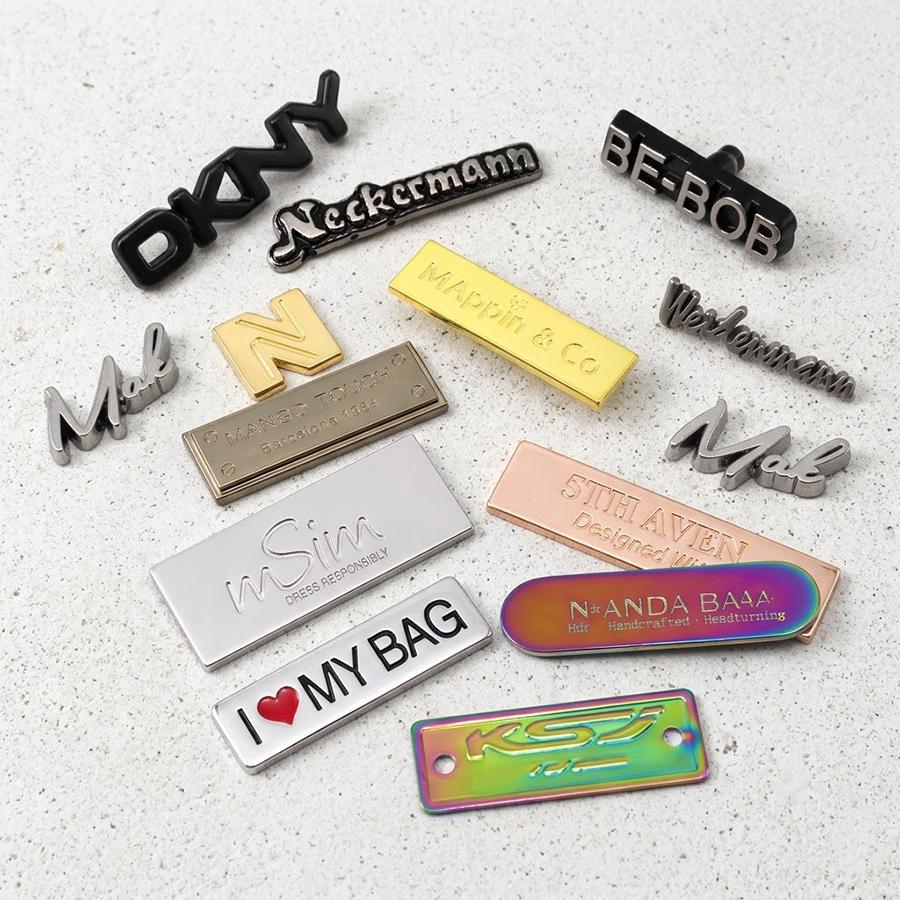
Metal labels built for bulk orders often fail in the exact places they're supposed to protect. These ones get laser-etched codes that stay legible after salt spray, sand blasts, and metal-on-metal scrapes. Acid baths and abrasive cleaners don't blur the marking or lift the edges. A custom stamped plate keeps its contrast through months of direct UV exposure and deep-freeze cycles without cracking or peeling. That means a maintenance team isn't walking the floor every season with a label printer and a roll of tape. The marking stays put because the material itself, not a printed overlay, carries the information. If the environment eats standard tags in a matter of weeks, these are built to look the same after the fifth washdown as they did on day one.
Mounting options remove the usual compromises. Riveted plates handle vibration and impact without loosening. Wrapped tags grip pipes, conduit, and rounded housings where flat labels curl away. Adhesive-backed metal labels bond to clean, irregular surfaces and stay there when temperatures swing from freezer floors to furnace doors. The same stock works across a cold storage rack and a heat-treat oven, which cuts the number of part numbers a buyer has to track. Instead of reordering labels every quarter, facilities can order once in bulk and know the tags will survive whatever the equipment goes through. That changes the label from a consumable into a fixed part of the asset record.
Contact Us
Contact Person: Jamie Zeng
Email: [email protected]
Tel/WhatsApp: +86 13728219269
Website: https://www.kmhardware.com