

Best Stainless Steel Hex Self-Drilling Screws That Won't Rust or Strip
2026-11-02
Finding screws that hold up under harsh conditions without rusting or stripping is a common frustration. Wanluo stainless steel hex self-drilling screws are engineered to end that struggle. In this guide, we'll look at why these fasteners stand out and how they can keep your next project secure for years to come.
Why These Screws Resist Rust Without Any Coatings
The secret lies in the alloy's internal structure, not in any surface finish. These screws are made from a precipitation-hardened stainless steel that forms a dense, self-healing chromium oxide layer the instant bare metal meets oxygen. Even if the surface gets scratched during installation, the exposed material immediately rebuilds that protective film, so rust never gets a foothold.
Beyond the passive film, the cold-forging process compresses the grain boundaries at the thread roots and under the head—the exact spots where corrosion usually starts on cheaper fasteners. That mechanical work eliminates microscopic voids and creates a uniform, low-porosity surface that moisture and chloride ions can't easily penetrate. No coating means no weak points where plating might chip or flake away later.
Finally, the nitrogen added during smelting locks up interstitial sites in the metal lattice, slowing down the electrochemical reactions that drive rust. This isn't a barrier you apply and then lose; it's the material's natural behavior in damp, salty, or industrial environments. The screws stay clean and functional simply because the base metal refuses to corrode on its own.
The Hex Head Design That Stops Slippage Cold
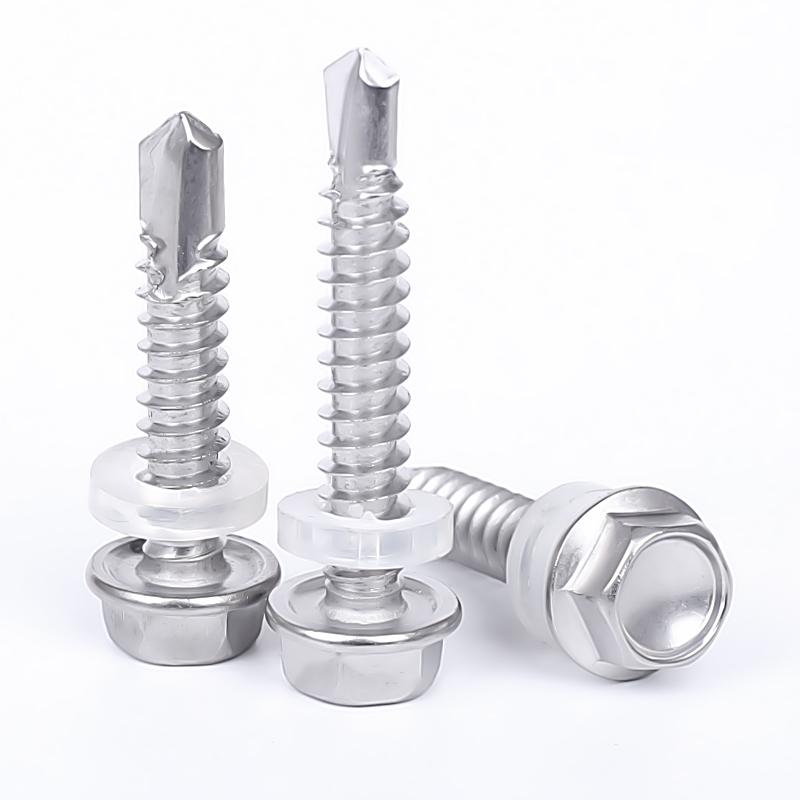
Most stripped screw heads start with a single moment of hesitation: the bit loses its bite, spins once, and then the corners are gone. The six-sided geometry here doesn't just offer more contact area—it locks the driver into place before torque even builds. Each flat face meets the tool at a fixed angle, so there's no ramp for the bit to climb or slip out of. That means you can lean into the fastener and feel the engagement stay solid from first turn to final set.
What sets this apart from a standard hex is how the tolerances are held. The walls aren't just milled to a generic size; they're matched to common driver dimensions with enough grip to prevent wobble but not so tight that you fight to seat the tool. You'll notice it most when working overhead or in tight spots where you can't apply perfectly straight pressure. The head forgives slight misalignment by keeping the driver centered, so the tool stays put instead of walking off.
For anyone who has rounded off a cheaper fastener mid-install, the difference is immediate. The hex profile spreads load across all six points evenly, which reduces the localized deformation that leads to spin-out. It's not a gimmick or a coating trick—it's a shape that simply works better under repeated use, especially with impact drivers. After a few projects, you stop checking whether the bit is seated. The head takes care of that for you.
How Self-Drilling Points Cut Through Sheet Metal Fast
The tip geometry does most of the work. A self-drilling point isn’t simply a sharpened cone; it carries a small, hardened drill-like flute that reams a pilot hole while the fastener rotates. Because the cutting edges are milled at an aggressive angle, they peel away thin sheet metal in tight curls instead of pushing material outward, which keeps the surrounding panel from dimpling.
Speed comes from how the threads engage immediately behind the cut. As soon as the point breaks through, the first thread grabs the fresh hole edge and pulls the fastener forward, so there is no pause between drilling and driving. The point’s heat treatment matters just as much: a harder tip stays sharp across dozens of joints, while the softer shank absorbs vibration without snapping.
Choosing the Right Length and Thread for the Job
The length you pick needs to match the total thickness of the materials being joined, plus a little extra for a solid bite into the base piece. A good rule of thumb is that the screw should penetrate at least half to two-thirds of the bottom material's thickness, but avoid poking through the far side unless the design calls for it. If you're fastening a thin board to a thicker one, measure the top piece and add about 12 to 25 millimeters for grip—going much longer rarely adds strength and just wastes material or risks splitting the wood.
Thread choice matters just as much as length. Coarse threads work well in softwoods, plywood, and particleboard because the wider spacing gives the fibers more room to compress and hold. Fine threads, with their tighter pitch, are better for hardwoods, metal studs, or anywhere you need more resistance to pull-out and less chance of stripping. For materials like MDF or plastics, consider a thread-cutting or high-low design that reduces cracking while still providing a firm anchor.
Real-World Uses From Gutters to Heavy Equipment
From residential gutter systems that quietly channel rainwater away from foundations to massive haul trucks rumbling across mining sites, the same principles of reliable material handling apply across vastly different scales. A seamless aluminum gutter on a suburban home may seem worlds apart from a steel dump body on a Komatsu HD785, yet both are shaped, cut, and welded to withstand constant abrasion, weather exposure, and structural stress. The difference is not in the core requirement—moving or diverting material under tough conditions—but in the thickness of the metal, the precision of the forming, and the type of reinforcement needed to keep things running year after year.
On construction and agricultural equipment, wear plates, chutes, and hoppers take a daily beating from rocks, grain, and debris. These components are often fabricated from high-strength alloys like Hardox or AR400, then cut with plasma or laser and assembled with deep-penetration welds. Even something as simple as a gutter leaf guard relies on the same fabrication logic: choose the right material for the expected wear, eliminate sharp corners that trap debris, and design joints that won’t pull apart when temperature shifts or heavy loads press down. It’s not glamorous, but it’s the quiet backbone of machinery that rarely stops moving.
What makes this cross-over interesting is how local fabrication shops adapt their tooling to both worlds. A press brake that bends 1/8-inch gutter coil can also form brackets for a skid steer attachment, just with different dies and back gauges. The skill of reading a blueprint, adjusting for springback, and knowing when a weld needs a backing bar doesn’t change because the end product sits on a roof versus a dozer blade. That’s why the same hands that roll a gutter machine in the morning might be cutting 3/4-inch plate for an excavator bucket by afternoon—and why “heavy equipment” and “gutters” aren’t as far apart as they first appear.
Preventing Stripped Heads Before They Happen
Most stripped screw heads start with a mismatched driver. If the bit doesn’t fill the recess fully, force concentrates on the tiny contact edges and rounds them over. Take a moment to check whether you actually need a #2 Phillips, a PZ2, or a square drive. Also inspect the bit itself; a worn or chipped tip will slip and chew up a brand-new fastener.
Pressure matters just as much as angle. Lean into the screw to keep the bit seated, but ease off as soon as the head reaches the surface. Many people keep the drill at full speed and full torque after the screw is already home, which is exactly when the bit starts to cam out. If your tool has a clutch, set it low and creep up until the screw seats without slipping.
Some joints simply invite trouble. Hard woods, dense composites, and metal-to-metal contact often need a pilot hole or a touch of lubricant on the threads. A small pilot hole reduces the torque demand dramatically, so the head never sees enough force to deform. And when you can, buy fasteners with deeper, cleaner recesses; cheap screws with shallow pockets will strip under normal use, no matter how careful you are.
FAQ
For most outdoor projects, yes. The key is picking the right stainless grade. 304 or 316 stainless gives excellent corrosion resistance, especially around salt air or rain. If you see rust staining after a few months, it's often from the bit or tiny steel particles left on the surface, not the screw itself. Wipe the heads down after installation and you'll usually avoid that.
Use a magnetic hex driver bit that fits snugly; most of these screws take a 1/4 inch or 5/16 inch bit. Don't run the drill at full speed the whole time; start slow until the threads catch, then speed up. Also, make sure you're driving straight in, not at an angle, because that is what strips the head faster than anything.
Yes, that is exactly what the self-drilling tip is for. For aluminum under about 1/8 inch thick, they usually drive right through without a pilot hole. Just keep steady pressure and let the screw do the cutting. If you're working with very thin metal, don't over-tighten, or the screw can spin out and lose its grip.
Add the thickness of the material you're fastening to the thickness of the material behind it, then add about 1/4 inch to 3/8 inch for the drill tip to fully pass through and the threads to bite. For example, if you're attaching 1/4 inch sheet to 1/8 inch tube, a 3/4 inch or 1 inch screw usually works. Too short and the threads won't engage; too long and the tip may hit something on the other side.
Some hardened stainless grades, like 410, can be less ductile than regular steel, but quality hex self-drilling screws are designed to handle driving torque without snapping. Avoid using an impact driver on max setting, and don't force the screw once it's seated. If you hear a pop, back off; that is the head twisting, not the screw failing.
It depends on thickness. Most standard self-drilling points are rated for up to 1/4 inch or sometimes 3/8 inch of mild steel. For anything thicker, you're better off pre-drilling a small pilot hole and using the screw's threads to tap in. Trying to drill through too-thick steel just dulls the tip and heats up the screw.
Check the hex head depth; deep, well-formed sockets grip better than shallow ones. Also look for screws with a reinforced neck or underhead shoulder, because that is where twisting usually happens. Buying from industrial fastener suppliers rather than generic box stores often makes a bigger difference than the alloy number printed on the box.
Conclusion
Not all stainless screws are created equal, and the best hex self-drilling options prove it by skipping fragile coatings altogether. Their rust resistance comes from the base alloy itself—typically 410 or 18-8 stainless—so there is no plating to flake off after a few seasons outdoors. The six-sided head is machined to hold a driver bit firmly, which matters when you are pressing against metal overhead or working at an awkward angle; the bit barely wobbles, and slippage becomes a rare event. That same stability carries over to the self-drilling point, a fluted tip that bores its own pilot hole through sheet metal without wandering. Pair the right point style with the job: shorter screws with fine threads for thin flashing, longer ones with deeper threads for structural steel or layered cladding.
In practice, these fasteners show up everywhere from gutter brackets and downspout straps to mounting plates on heavy equipment, because they hold without needing a separate drill step. But even a rust-proof screw can fail if the hex socket rounds out. Avoiding stripped heads starts before you pull the trigger—use a bit that matches the head size exactly, keep the driver square to the screw, and let the tool do the work instead of leaning in hard. If you feel the bit start to cam out, stop and reseat it. That small habit, combined with the right alloy and thread choice, keeps a box of these screws earning their place in your tool bag long after cheaper coated fasteners have corroded or lost their grip.
Contact Us
Contact Person: Shane
Email: [email protected]
Tel/WhatsApp: 8613357785029
Website: https://www.wanluohardware.com